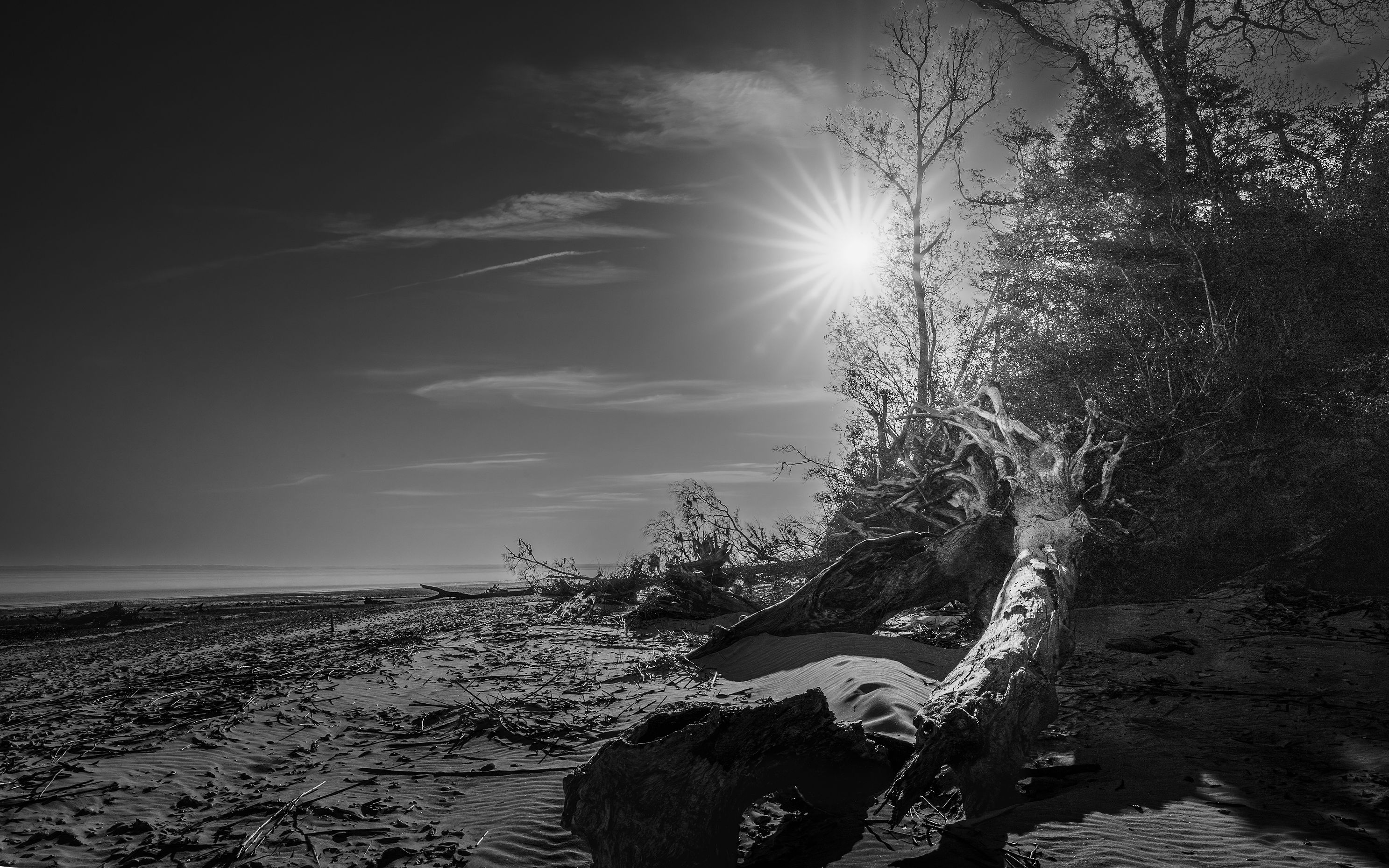
Nature has a remarkable way of reminding us that even in destruction there is beauty. While hiking through the trails of Pinckney Island National Wildlife Refuge near Hilton Head Island, South Carolina, I was searching for wildlife and coastal landscapes. Instead, I found something entirely unexpected—a massive fallen tree that had become a work of art sculpted by time, weather, and the relentless forces of nature.
After a 30-minute hike to the easternmost shoreline of Pinckney Island, I stepped onto the beach and immediately recognized a composition that I knew belonged in my fine art portfolio.
The morning sun was breaking through the row of shoreline trees, creating dramatic rays that pierced the canopy while casting deep, textured shadows across the sand. Opposing those rich shadows was a brilliantly illuminated sky, producing the kind of dynamic contrast that instantly captures a photographer's attention. The uprooted tree stretched diagonally across the beach, its weathered trunk and tangled root system naturally guiding the viewer's eye toward the brilliant starburst sun.
I spent several minutes studying the scene before setting up the photograph. Rather than photographing the tree from eye level, I lowered the camera close to the sand. This perspective emphasized the powerful leading lines of the fallen trunk, allowing the viewer's gaze to travel along the beach and ultimately arrive at the radiant sunlight filtering through the trees. The composition transformed what might have been viewed as a fallen obstacle into the unmistakable centerpiece of the landscape.
Black-and-white was the natural choice for this image. Removing color allows the viewer to focus on the dramatic interplay of light and shadow, the intricate textures of the weathered wood, and the sculptural quality of the fallen tree. The result is an image that emphasizes form, contrast, and emotion rather than color alone.
Technically, this photograph was captured using a 24mm focal length at f/20, 1/2500 second, and ISO 200. The small aperture created the distinctive sunstar while maintaining sharpness from the foreground driftwood to the distant horizon, preserving every detail that first drew me to the scene.
One of the things I enjoy most about landscape photography is that remarkable compositions often appear where you least expect them. A fallen tree is easily overlooked as storm debris, yet with the right light and perspective it becomes a symbol of resilience, endurance, and the ever-changing character of our coastal landscapes.
"Fallen" serves as a reminder that nature is constantly reshaping itself. What once stood proudly along the shoreline now rests on the sand, creating an entirely new story—one that exists only because time, tides, and storms combined to create a fleeting moment worth preserving.
If you visit Pinckney Island, take your time. Slow down, explore beyond the obvious viewpoints, and allow the landscape to reveal its hidden compositions. You may discover, as I did, that some of the most compelling photographs aren't found in pristine scenes, but in the quiet beauty left behind after nature has done its work.
The Takeaway
Nature has a remarkable way of changing our perspective—if we're willing to slow down and truly look.
When I first came upon this fallen tree, it would have been easy to see only storm damage and decay. But by changing my perspective—both physically with the camera and mentally as an observer—I discovered something entirely different. The weathered trunk became a leading line, the tangled roots became sculpture, and what once stood as a living tree had become a work of art shaped by time.
Landscape photography continually reminds me that beauty isn't always found in perfection. Sometimes it's found in resilience, in change, and in the quiet stories that nature writes long after the storm has passed. As a reference, every time I return to Pinckney Island, I look for this tree. It reminds me that some of the most compelling photographs are the ones we never set out to find.
The next time you find yourself outdoors, don't just look for the obvious. Slow down, change your perspective, and you may discover that what first appears to be an ending is actually the beginning of a remarkable photograph.